A litre of petrol is made up by the cost of the petrol itself (wholesale cost, bio fuel content, delivery costs, retailer profit). To this a fixed fuel duty rate (currently 52.95p/litre) is added. VAT at 20% is then applied on top. The example cost of a litre of fuel I've used is 130.1p.
Electricity for EV charging is different. For starters there is currently no fuel duty tax added to EV charging. VAT on electricity from home charging is charged at 5%, whilst VAT on public charging is charged at 20%.
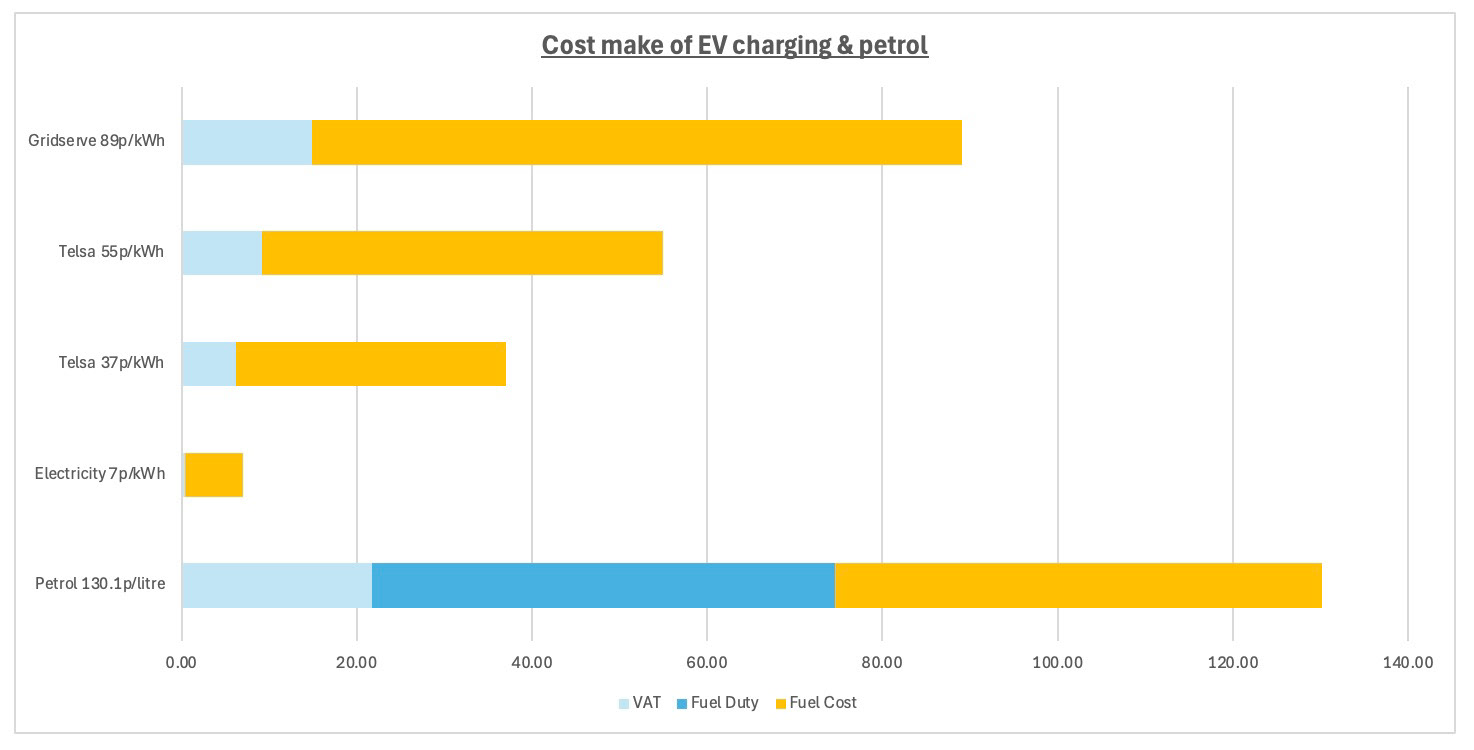
Its quite obvious that currently tax makes up 57% of a litre of petrol. Tax makes up for about 5% of EV home charging at 7p/kWh and 17% of the cost of public charging.
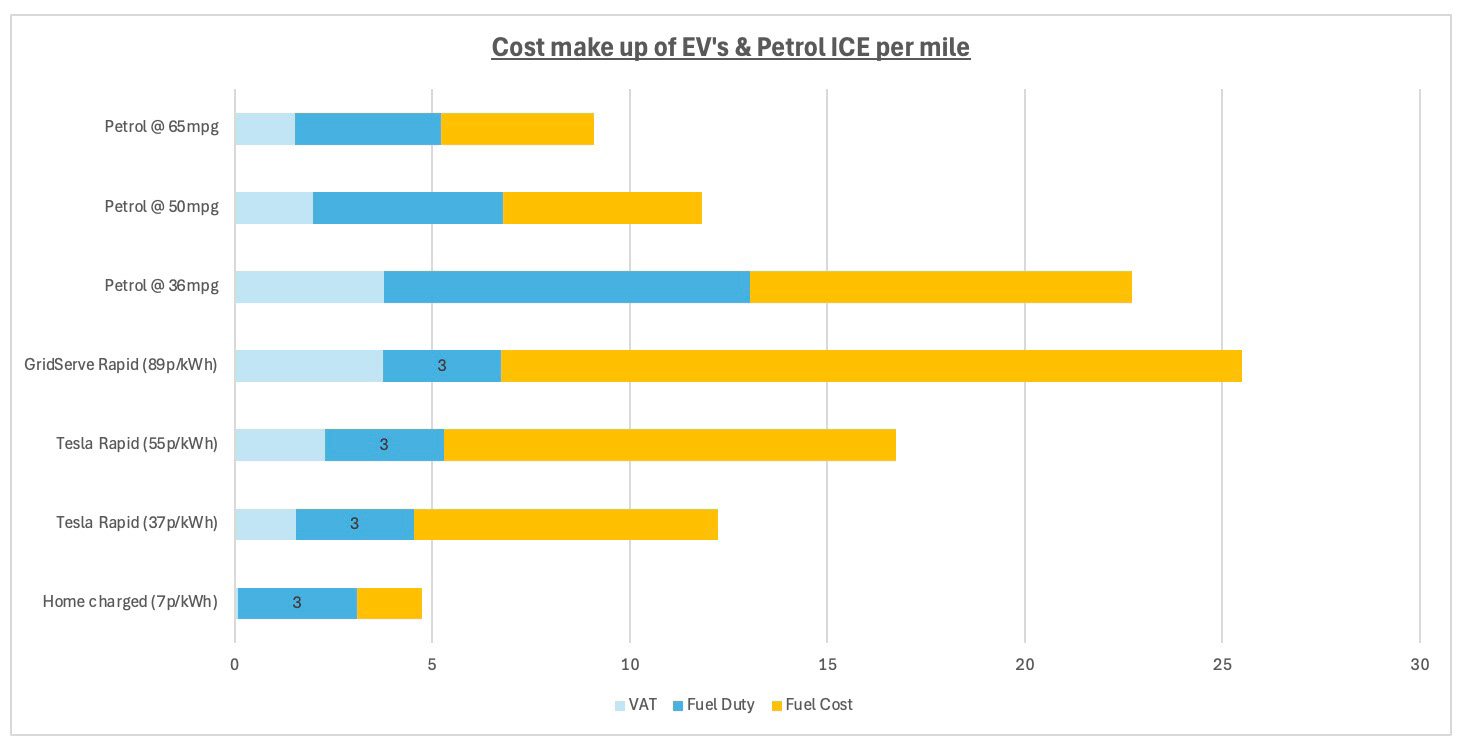
The problem is we can't compare the tax level of a litre of petrol to a kWh of electricity because they have two different energy density's. We have to change to a comparable unit, which is cost per mile. This then brings efficiency into consideration as the more efficient a vehicle is the less fuel is used, therefore less tax is paid per mile. I've compared petrol efficiency from 36 mpg through to 65 mpg.
A petrol vehicle at 50 mpg pays just over half in tax (6.8p/mile) to a petrol vehicle at 36 mpg (13p/mile). A petrol vehicles with an efficiency of 65 mpg pays 5.2p/mile in tax.
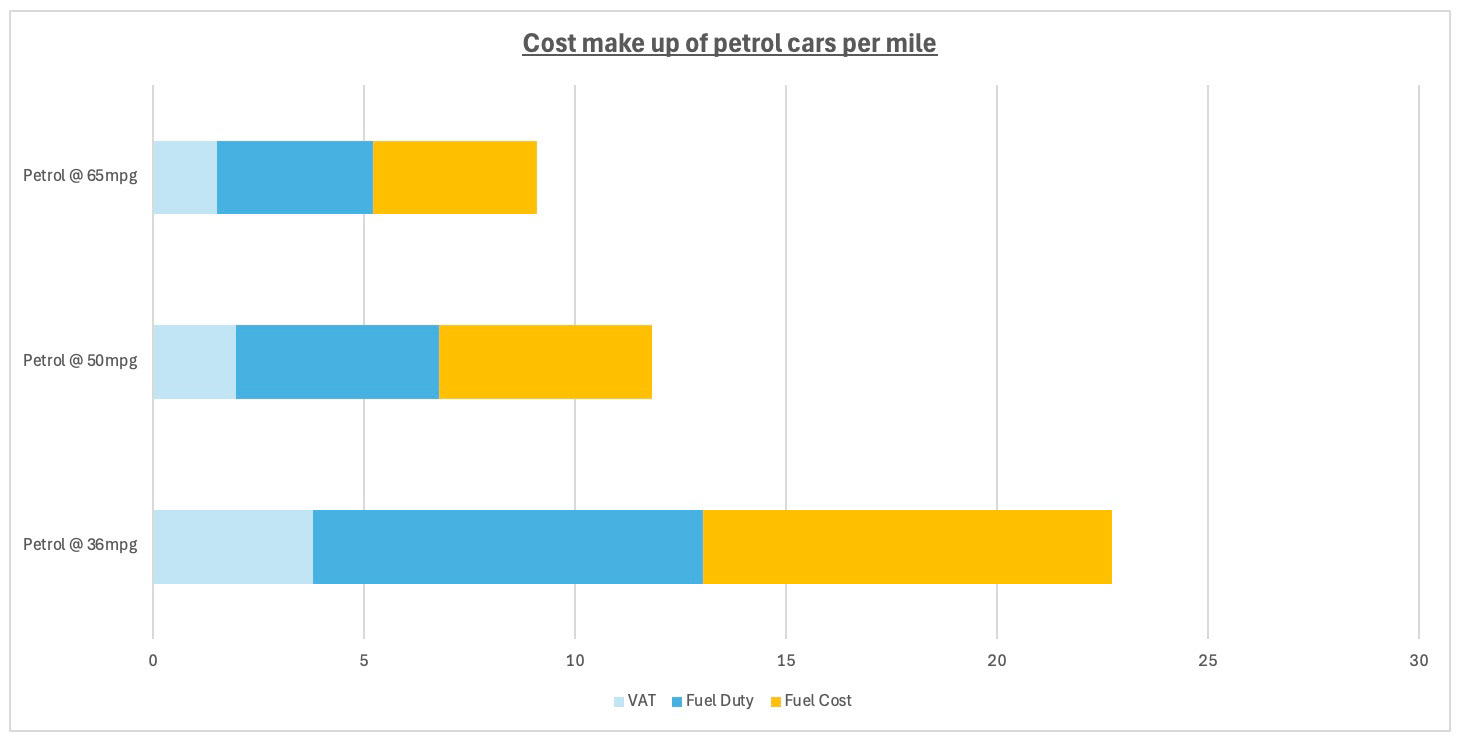
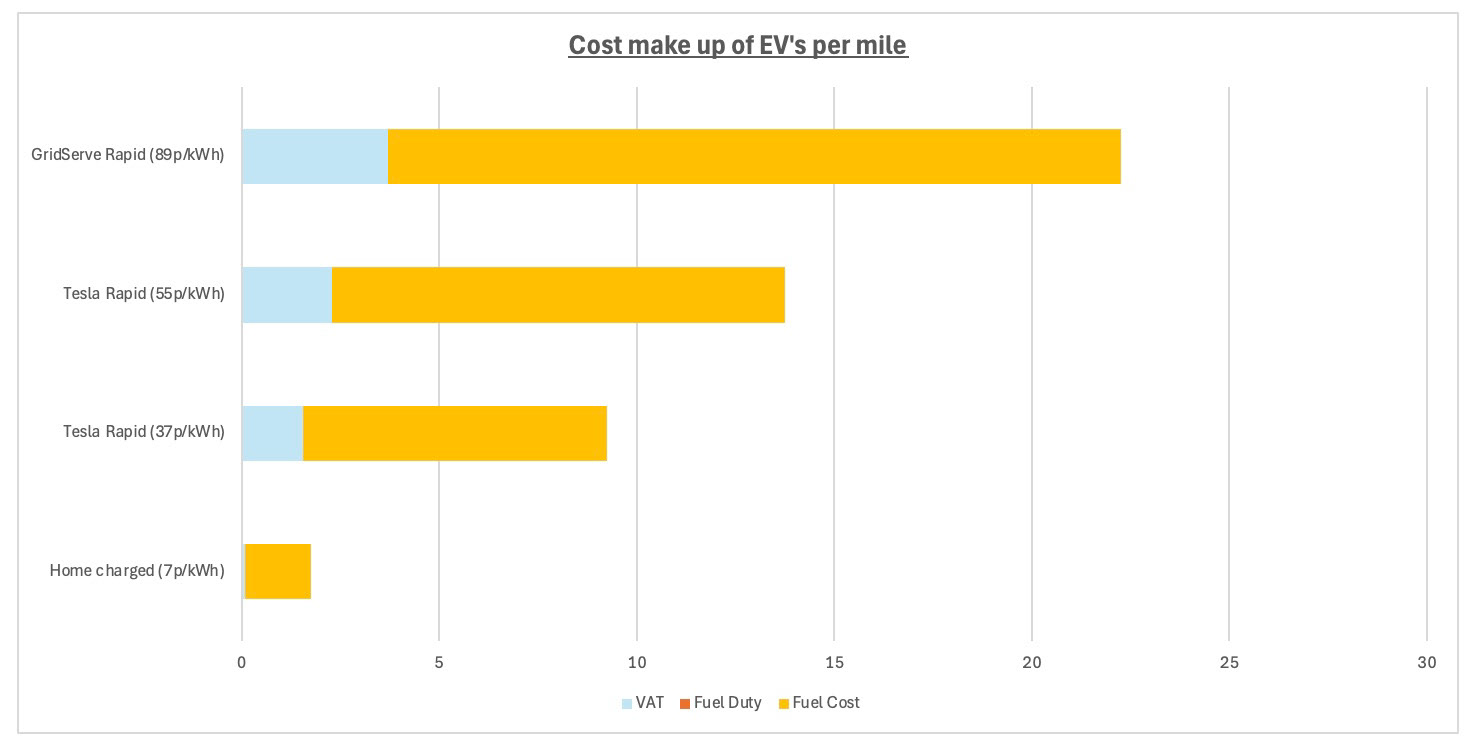
If we look at an EV, whilst the efficiency can change between EV's, unlike petrol the greatest cost difference is the cost of charging an EV depending on location and type. I've therefore not included EV efficiency in the calculations. Just like a petrol car the more efficient a car is the less tax is paid.
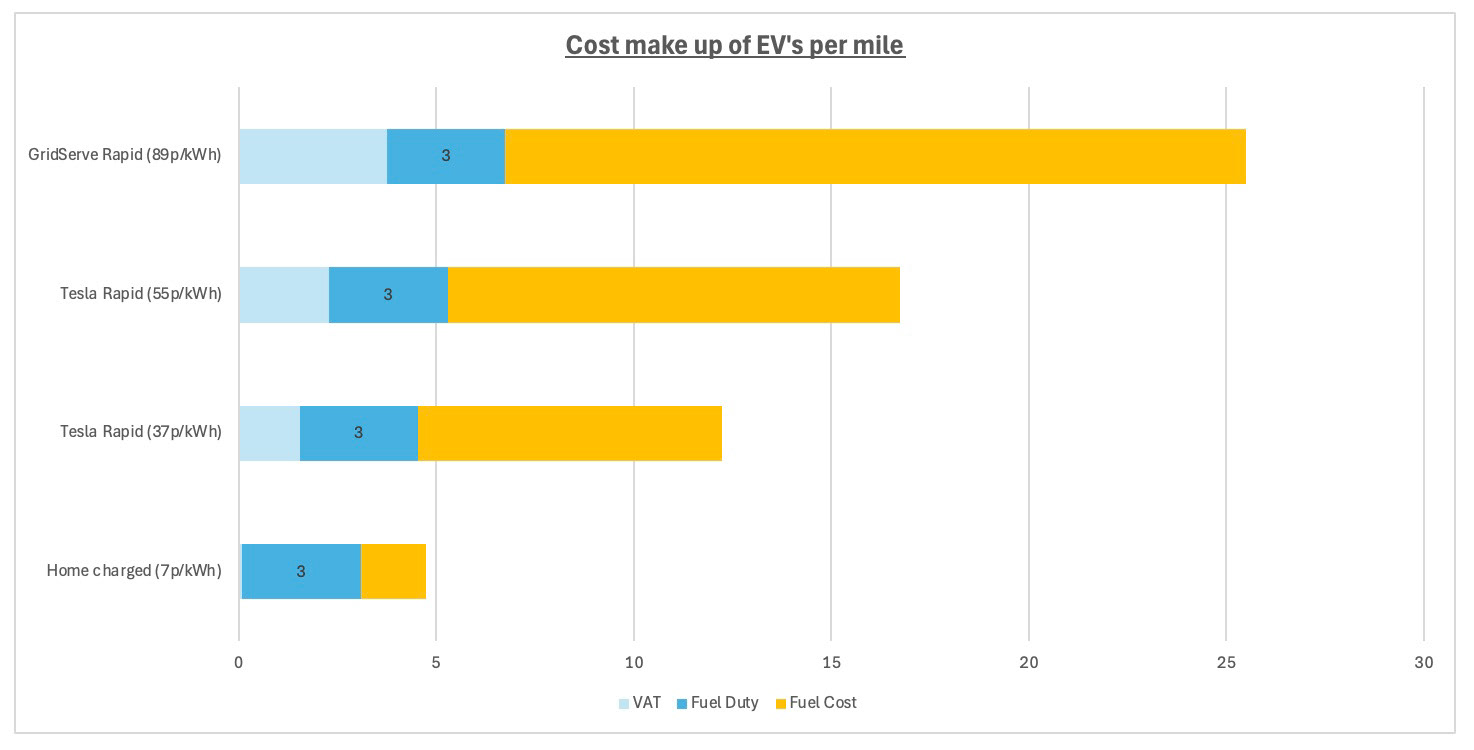
Home charging an EV via a specific EV tariff can be as low as 7p/kWh, whilst public charging can range from 37p/kWh to 89p/kWh. Whilst VAT take increases with the cost of a kWh, a home charged EV at 7p/kWh is taxed at just 0.08p whilst a tesla at 55p/kWh is taxed at 2.3p/kWh. At GridServe charger at 89p/kWh is taxed at 3.7p/kWh.
Recently it has been confirmed that EV's will be charged an extra 3p per mile from April 2028 in a pay per mile 'tax'. It does make sense that pay per mile charge is applied to EV's as 'fuel duty' cannot be applied for home charging as an EV can be charged off a 3 pin plug or solar panels. As we already know many EV's charge mainly at home, therefore applying a fuel duty only to public charging wouldn't make up for the loss of tax income from the change from ICE to EV's. It would also make running an EV solely using public charging very expensive.
A cost per mile will increase the tax aspect paid by EV's from the cost per mile perspective. Tax paid by a home charged EV at 7p/kWh would increase from 0.08p to 3.08p per mile.
The tax paid by an EV charged at a Tesla supercharger at 55p/kWh would increase from 2.3p/mile to 5.3p/mile.
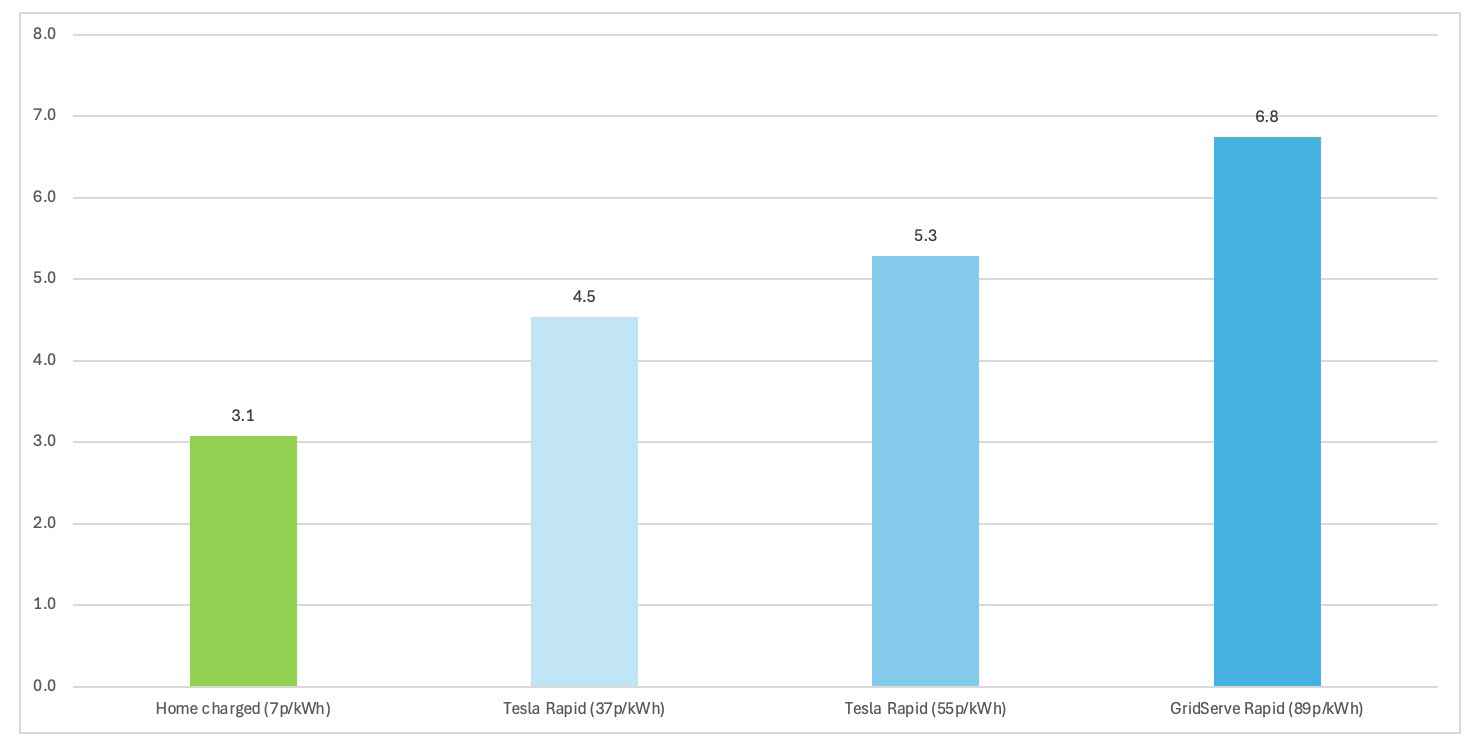
Total tax incurred by different charging types
If we look at the tax aspect of the overall cost per mile the standout point remains that the cost of rapid charging is mainly made up by the 'fuel cost' public charging. This means that the per mile cost of an EV charged using public charging can be much higher than that of a home charged EV, and the tax paid will be much higher too.
When we compare the cost per mile of petrol and EV's we can see that home charged EV's will still have the lowest cost per mile. An EV charged at 37p/kWh will have a similar cost per mile to that of a petrol car at 50 mpg. An EV charged using a GridServe charger at 89p/kWh will cost slightly more per mile to a petrol car at 36 mpg. What we can notice is that the tax paid by EV's will generally be lower than a petrol car.
Hopefully the cost per mile of public charging shall drop as economy's of scale reduce the cost of providing pub lic charging.
With the introduction of pay per mile for EV's it does pose the question whether the VAT rate on public charging could be dropped to 5% to match the VAT rate on home electricity, and made up with higher pay per mile tax instead.
What this would do is equalise the tax aspect of EV charging no matter whether you were using home or public charging as the tax aspect would only vary between 3.1p/mile for home charging and 3.9p/mile for the most expensive public charging. Whereas with 20% VAT on public charging and 5% VAT on home charging the VAT per mile ranges from 3.1p/mile for home charging to 6.8p/mile for the most expensive public charging.
It would also help to reduce the cost per mile of expensive public charging too. GridServe at 89p/kWh would decrease from 25.5p/mile to 22.5p/mile if the VAT rate was dropped to 5%.
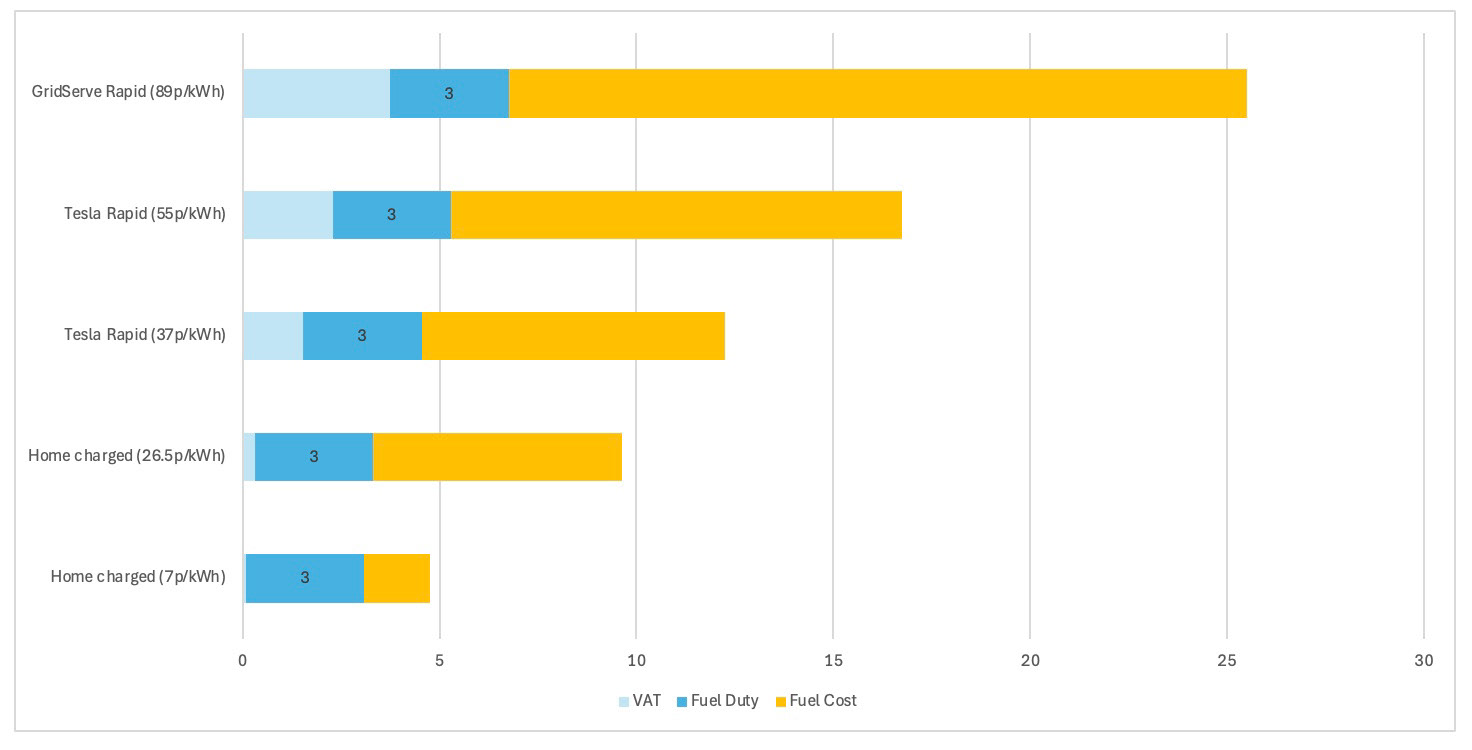
Cost per mile if public EV charging is 20% VAT & home EV charging is 5% VAT
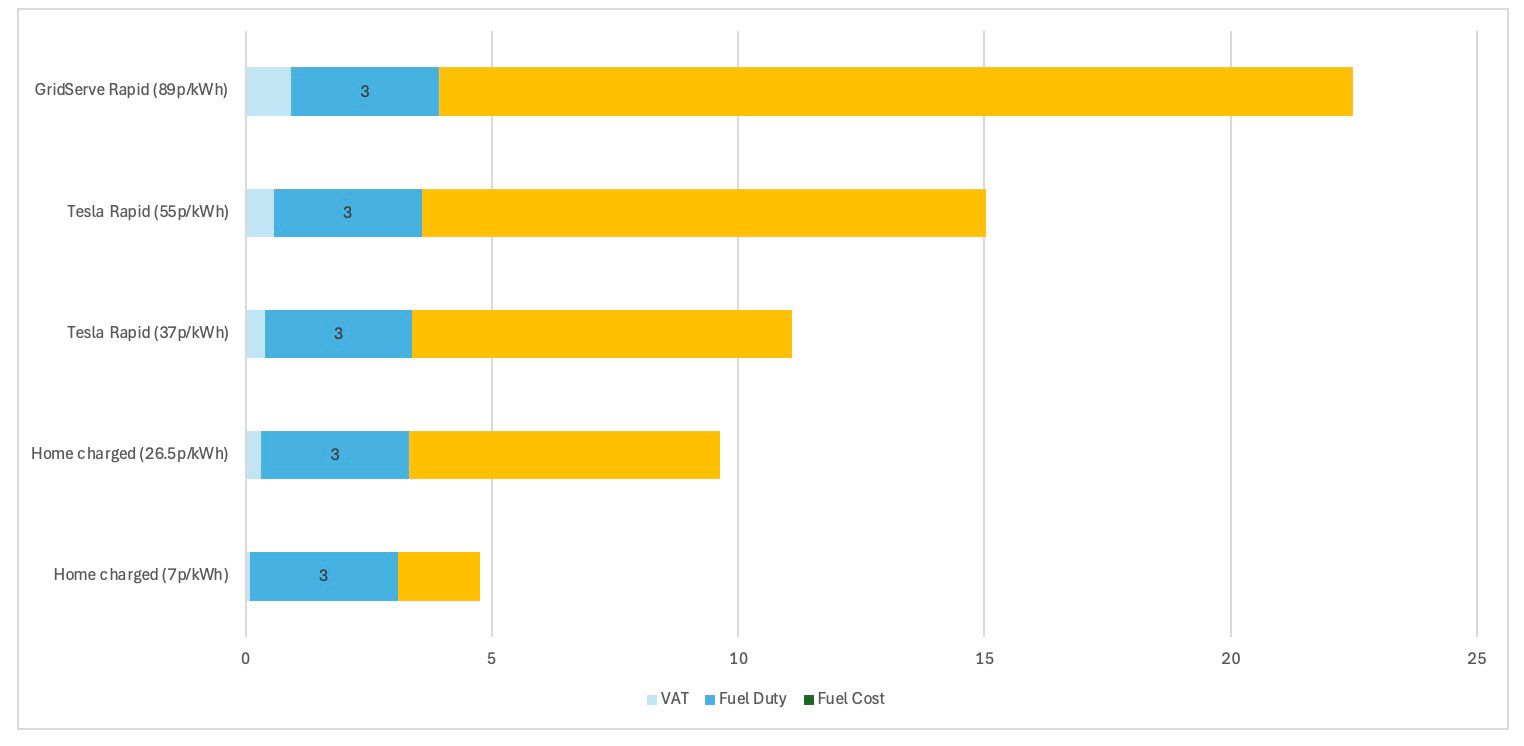
Cost per mile if public & home EV charging both had 5% VAT rate
This would be fairer to those who don't have home charging as they would pay similar tax level for EV charging to those who have home charging. They would still pay more for EV charging as public charging would still be more expensive than home charging, but at least tax incurred would be closer than it is now.